Resources
& FAQ
Use the following links to jump to your desired section.
Poly Calculator
This Excel spreadsheet provides comprehensive formulas for your poly-sizing needs.

General Questions
Our most frequent questions and answers
Yes! Minimum quantities vary depending on the products ordered.
Please provide specification details such as style, order qty, dimension(length*width*height), material,thickness,color, logo printing,etc. Simply contact our professional team and we’ll help you.
Flexographic printing is the method of printing on a web press using rubber or photopolymer plates with raised images. Rotogravure printing does not use plates, rather the image is etched directly onto a cylinder. It can be distinguished when looking through a loupe – it has teeth like marks around type and solids.
Designed for wicket bagger machines, wicketed pouches are premade pouches with holes at the top designed for hanging on wickets. Wicketed pouches are grouped together and loaded on wickets. This allows them to be loaded onto a wicket bagger machine for filling (or they can also be manually filled).
Mil is the thickness measurement of a film. For example 1 mil is presented at 0.001 mil.
Maximum outside diameter is the size roll that a process can handle and is usually dictated by the weight the processing equipment can handle or the amount of clearance available on the wind or unwind. For example, we make rolls up to 24” OD.
Converting is simply changing something into a different form. In the case of flexible packaging, converting would be the process of utilizing films, foils and resins and through the process of lamination, forming them into a multilayer structure.
The U.S. Food and Drug Administration (FDA) regulates the safety of all plastics currently used in food packaging and food contact materials.
Wind direction is specified when ordering so that the film can be unrolled in the direction needed for further processing.
•••
Poly FAQ
All things poly
Polyethylene is defined as a thermoplastic polymer with variable crystalline structure. It has a very large range of applications depending on the exact type and is one of the most widely produced plastics used across the globe with tens of millions of tons being produced each year. Typically, High Density Polyethylene (HDPE) is the most common form of PE and has a higher density than other forms.
For food grade packaging poly films – what is the difference between FDA, USDA, CFIA and Kosher approval? These standards are all different. Visit our certifications page for an explanation or contact us.
Polyethylene terephthalate (PET) is a form of PE, but is specifically used for blow molding into plastic bottles, personal care products, and other consumer products. PET is great for packaging materials because of its ability to be durable and lightweight at the same time.
- Low Density Polyethylene (LDPE)— This type of PE is quite flexible and posses unique flow properties, which makes it particularly suitable to plastic firm applications. LDPE is commonly used for plastic shopping bags and elastic products.
- Linear Low Density Polyethylene (LLDPE)— This type of PE has all the advantages of LDPE but involves formula adjustments and requires far less energy than LDPE.
•••

To ensure that you have the very latest when it comes to films and additives, we have everything under the sun – and out of it if need be.
ANTI-BLOCK
Blocking is the term used to describe what happens when polyethylene film sticks together. Anti-block is an additive that roughens the surface of film at a microscopic level. This makes it easier for layers of film to separate. Anti-block makes bags easier to open, too.
ANTI-STATIC
For static sensitive applications – like packaging for electronic parts or for static sensitive automated packaging or mailing equipment – anti-static additives lower surface resistivity and static decay times. All Laddawn anti-static additives are amine-free: that means they work better in lower relative humidity, and won’t corrode polycarbonate surfaces.
Note: To meet the full static decay and surface resistivity requirements of MIL-PRF-81705D Type II Class 1 and EIA-541, films must be 4 mil or greater and formulated with 6% or more Laddawn anti-static additive. All Mil Spec anti-static films must be manufactured with low density (LDPE) resin. Linear low density (LLDPE) resin is extruded at higher temperatures which may cause a loss of anti-static performance.
HIGH-DENSITY POLYETHYLENE
The chemical structure of high density polyethylene (HDPE) lends itself to greater toughness – roughly twice the tear and puncture strength and better chemical resistance than low density polyethylene (LDPE) and linear low density polyethylene (LLDPE). On the downside, HDPE film is less flexible and less clear than its LDPE and LLDPE cousins.
LOW-DENSITY POLYETHYLENE
Low density polyethylene (LDPE) is a popular choice for a wide range of light-weight packaging needs. LDPE provides moderate strength and good clarity for general purpose applications. A commonly used type of LDPE is actually called Clarity.
CLARITY
For smaller bag, film and tubing applications, where higher transparency is more important than product strength, items are formulated with a type of low density polyethylene (LDPE) resin called Clarity.
LINEAR LOW-DENSITY POLYETHYLENE
When film strength is more important than clarity, linear low density polyethylene (LLDPE) is often the right choice. LLDPE provides better tear and puncture resistance for larger capacities or bulky objects. Two great options for LLDPE are Hexene and Octene.
HEXENE
Hexene is a very strong linear low density polyethylene (LLDPE) that stands up to more rigorous demands. Hexene is the most common choice where added strength is important.
OCTENE
Octene is the strongest linear low density polyethylene (LLDPE). For a few pennies more per pound, Octene delivers the highest tear and puncture strength of any LLDPE material.
NON-SCRATCH
There’s really only one component in most low or linear low density polyethylene bags, film or tubing formulations that can be at all scratchy: anti-block. Anti-block additives work by making the surface of the film rougher. Non-scratch bags, film and tubing contain no anti-block additives and therefor provide smoother film surfaces.
METALLOCENE
Metallocene’s prime benefit is its ability to make film more resilient. Metallocene may not improve the force needed to tear a film, but it will allow it to stretch more under force and seal better. Even at lower temperatures, items formulated with metallocene don’t become brittle. That’s why metallocene is the choice for freezer or ice bags.
POLYPROPYLENE
Polypropylene (PP) is the choice when clarity is paramount. Polypropylene offers about five times the clarity (one-fifth the haze values) of Clarity low density polyethylene. Polypropylene is a common choice when packaging for display.
POSTAL APPROVED
These items are formulated to comply with the USPS T-3204 protocol for use on automation rate flat-size mail pieces. Performance standards met include haze, blocking, coefficient of friction and static charge decay.
SLIP
Slip additives decrease the coefficient of friction (increase the slipperiness) of the surface of a bag, film or tubing. Standard formulations have enough slip additive to keep bags, film or tubing from sticking together but not so much as to make them difficult to handle.
HIGH SLIP
Some users require increases in slip additive to increase the degree to which their bags, film or tubing glide in a handling or packaging process.
LOW SLIP
Some users require low slip bags, film or tubing to decrease the likelihood of their product sliding when packaged. Mattress bags are a good example. Low slip bags are formulated with no slip additive.
UVI/UVA
Direct sunlight (UV light) causes unprotected film to discolor or become brittle. UVI/UVA (ultraviolet light inhibitor / ultraviolet light absorber) protects both the film and its contents from the damaging effects of the sun and inhibits thermal degradation of the film. Do not use UVI/UVA additive for film that may come in contact with agricultural chemicals or pesticides as they may reduce the product’s efficacy.
VCI
Packaged metal items can corrode during storage or shipment if exposed to oxygen, water and other contaminants. A Vapor Corrosion Inhibitor (VCI) is a film additive that has enough vapor pressure under normal circumstances to become a gas. VCI fills the interior of a sealed bag with molecules that adsorb onto the surface of a metal item to form a microscopic, protective barrier.
Note: All VCI film, bags and tubing must be formulated with low density (LDPE) resin. Linear low density (LLDPE) resin is extruded at higher temperatures which may reduce the concentration of VCI in the final product.
•••
Need help measuring
your products?
Sizing them up, down, and every which way.
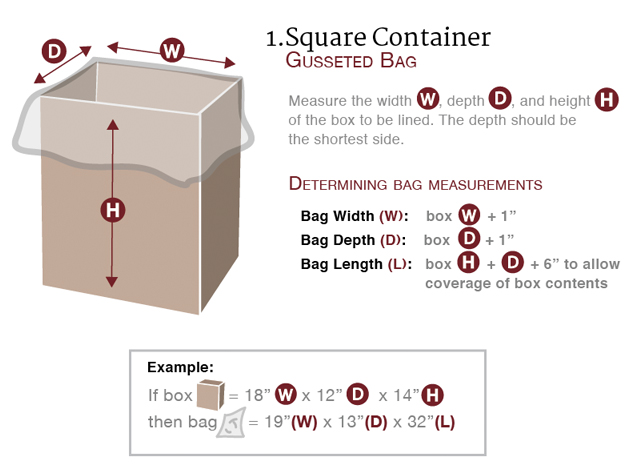
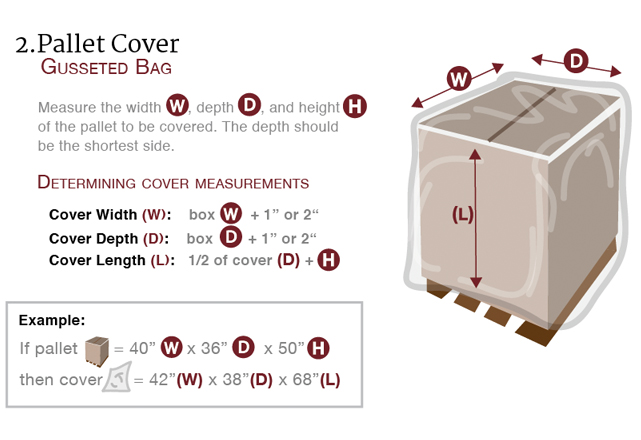
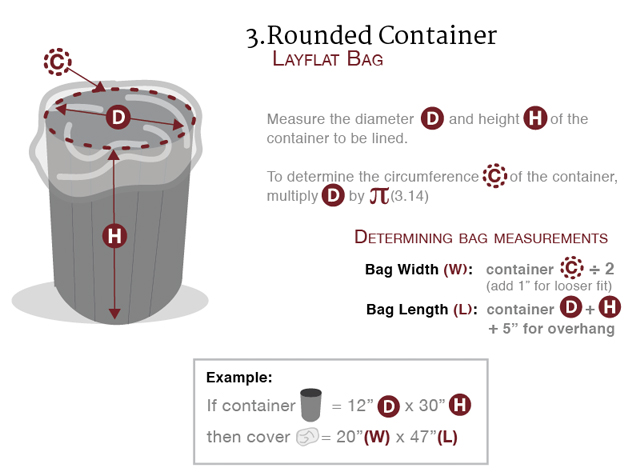
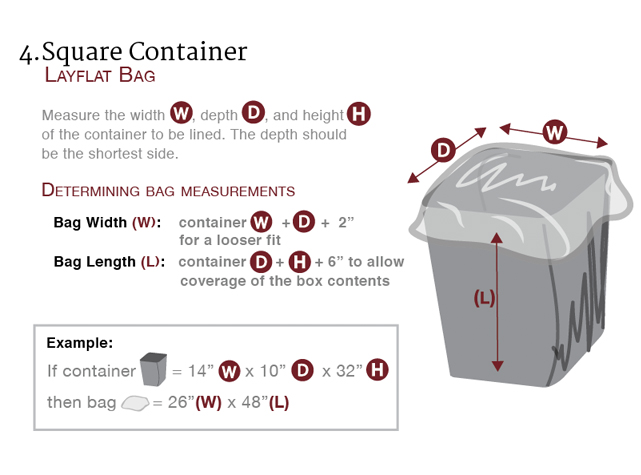
Here are 4 simple formulas to ensure you get the right fit.